Corporate carbon footprint services built for scrutiny.
Customers, banks and regulators now expect mid-size companies to show emissions numbers that can be checked. Habitat delivers corporate carbon footprint services to the GHG Protocol Corporate Standard — Scope 1, 2 and 3 — in three clear tiers, from a first baseline to an assurance-ready inventory, with scope, timeline and price in writing.
Who is asking for your numbers?
A corporate carbon footprint used to be a voluntary exercise. In 2026 it arrives as a request you cannot ignore — usually from three directions at once.
Companies reporting under CSRD — after Omnibus I, those with more than 1,000 employees and more than EUR 450 million net turnover — must cover their value chain, and in California, SB 253 scope 3 reporting begins in 2027. Their reporting duty becomes your data request.
Bank ESG questionnaires increasingly follow the VSME standard (Recommendation (EU) 2025/1710), which is designed as the cap on what large companies and banks may ask SMEs for. EcoVadis and CDP both score you on whether your emissions are measured, not guessed.
If you produce CBAM goods for the EU market, Regulation (EU) 2023/956 defines exactly what your EU customer must declare — and installation-level emissions data is at the centre of it. One properly built inventory is the foundation for that answer too.
The pattern behind all three: whoever asks, the question is the same inventory. Measure once to a recognised standard, and every questionnaire, tender and data request draws on the same defensible numbers.
One footprint, three tiers.
Three measurement tiers and one planning add-on, so you buy the depth your buyers actually demand — no more. Every engagement is scoped in writing — scope, timeline and price — with a fixed-fee quote within 48 hours.
Most first engagements start at tier one or two: a defensible baseline, delivered with the methodology note that lets next year's figure be compared to this year's.
Pick the tier your buyers will accept.
| Tier | Scope coverage | What you receive | Built for |
|---|---|---|---|
| Baseline | Scope 1 + Scope 2, with Scope 2 reported both location-based and market-based | Emissions inventory, methodology note, a comparison basis for every following year | First-time measurement; bank and customer questionnaires |
| Full footprint | Scopes 1, 2 and 3 — screening across all 15 GHG Protocol Scope 3 categories | Full inventory, hotspot analysis, supplier data plan | Suppliers to companies reporting under CSRD or SB 253 |
| Assurance-ready | Scopes 1, 2 and 3 with verification-grade documentation | Evidence files, documented boundaries and factor choices, support through third-party verification | Inventories that must survive an auditor or an accredited verifier |
Every tier follows the GHG Protocol Corporate Accounting and Reporting Standard, with country-specific emission factors — never regional averages.
The GHG Protocol, applied properly.
Every inventory we build follows the GHG Protocol Corporate Accounting and Reporting Standard: Scope 1 for direct emissions from sources you own or control, Scope 2 for purchased electricity, steam, heat and cooling, Scope 3 for everything else in the value chain. Scope 2 is reported twice, as the Scope 2 Guidance requires — a location-based figure built on grid-average factors and a market-based figure built on your contracts and certificates — because the two numbers answer different questions.
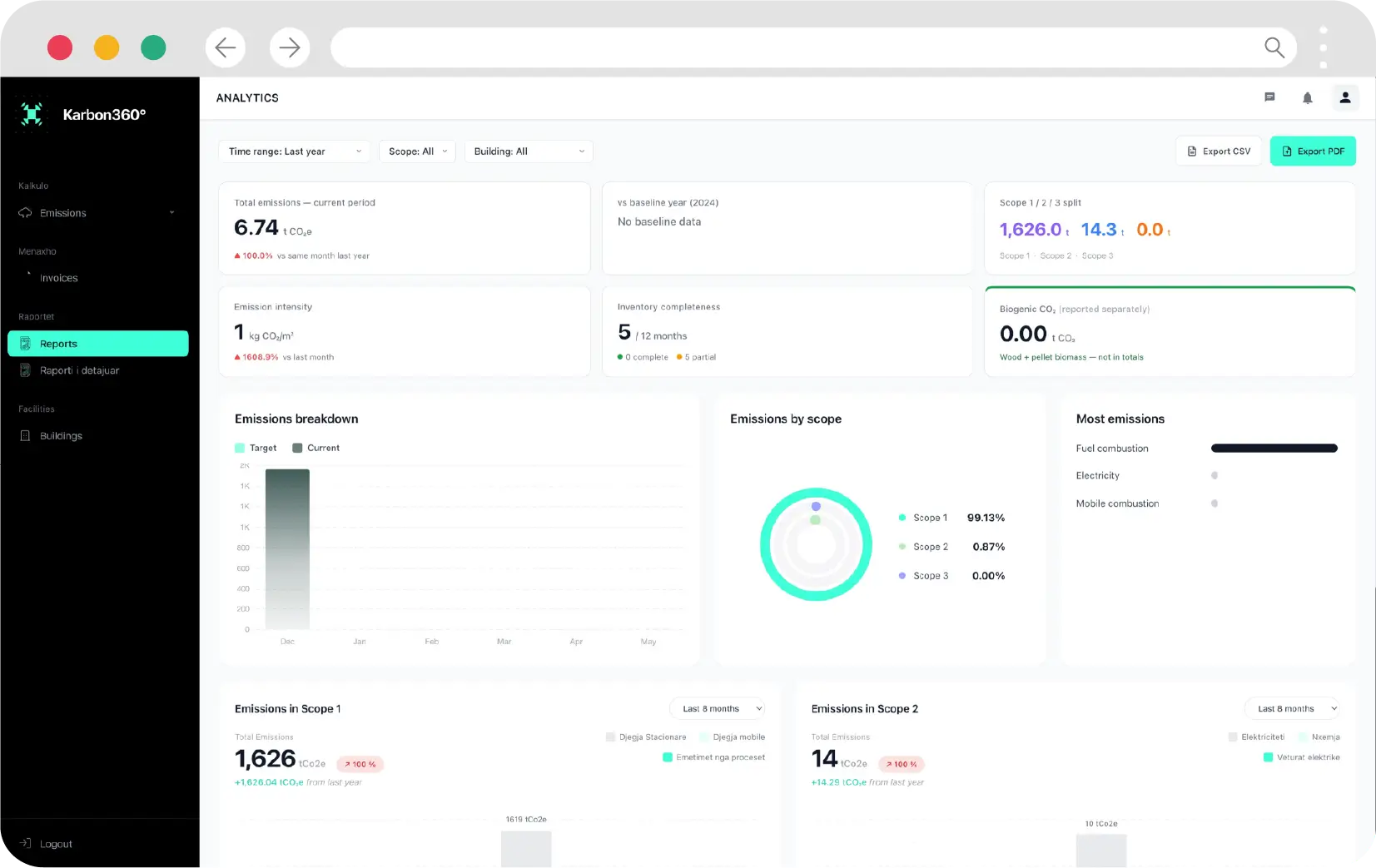
The real work of a GHG Protocol carbon footprint consultant is the unglamorous part: setting organisational boundaries, choosing country-specific emission factors for every market you operate in, and documenting each decision so the number survives questioning. The calculations and the audit trail live in Karbon360°, our own platform, so your inventory is structured data from day one — not a spreadsheet that dies with the person who built it.
Karbon360°
Karbon360° transforms energy and business activity data into structured greenhouse-gas inventories — Scope 1, 2 and 3 calculations, country-specific emission factors and the evidence trail behind every figure, in one place.
An emissions number you cannot document is an estimate, not an inventory.
Mid-size companies and industrial exporters.
Most of our clients are mid-size companies without a sustainability department: a finance lead or quality manager has been handed a questionnaire, a tender clause or a customer deadline, and needs a greenhouse gas inventory consultant for a mid-size company budget — not a Big-4 programme. The engagement is built around that reality. We collect the data your teams already hold — energy invoices, fuel records, production figures — do the methodology work ourselves, and hand back numbers your own people can explain. If the trigger was your bank's ESG questionnaire, the baseline tier typically covers what is being asked.
For industrial companies in the Western Balkans the stakes are commercial, not voluntary. More than 60% of the region's goods exports go to the EU, which makes it one of the most CBAM-exposed regions in the world — and when your products fall under a CBAM data request from an EU customer, the importer is legally required to declare embedded emissions, with default values carrying a mark-up of 10% for 2026 imports, 20% for 2027 and 30% from 2028. Verified, installation-level data is becoming a selling point. A decarbonisation roadmap for an industrial company in the Balkans starts from exactly this footprint: measure first, then sequence the energy and process measures that cut both emissions and exposure.
Frequently asked.
What do corporate carbon footprint services include?
What does a GHG Protocol carbon footprint consultant actually do?
Do mid-size companies legally have to measure their carbon footprint?
How much does a corporate carbon footprint cost?
How long does a corporate carbon footprint take?
What is a decarbonisation roadmap, and when do we need one?
Measure once, answer everyone.
Tell us who is asking for your numbers — a customer, a bank, a rater or an EU buyer. We come back within 48 hours with the right tier, a data checklist and a fixed-fee quote in writing.