The first CBAM annual declaration is due 30 September 2027.
Under Regulation (EU) 2023/956, as amended by Regulation (EU) 2025/2083, the first CBAM annual declaration is due 30 September 2027 and covers goods imported during 2026. Every authorised CBAM declarant must file it — and surrender certificates for those 2026 imports by the same date. This page tracks the dates that moved, the dates that hold, and the steps between now and filing.
One deadline, three dates: the paper trail.
The original CBAM Regulation — Regulation (EU) 2023/956 of 10 May 2023 — set the annual declaration deadline at 31 May of the year following the import year. Under that text, the first declaration would have fallen on 31 May 2027. That date still circulates in older guides and AI answers. It is no longer the law.
In February 2025 the Commission's simplification proposal floated 31 August instead. That date made it into plenty of 2025 commentary, but it was only ever a proposal and was never adopted.
The final word is Regulation (EU) 2025/2083 — an amending regulation of the European Parliament and the Council, adopted 8 October 2025, published in the Official Journal on 17 October 2025 and in force since 20 October 2025. It moved the deadline to 30 September. The first annual CBAM declaration is therefore due 30 September 2027, covering 2026 imports, and the certificates for those imports must be surrendered by the same date.
The practical test is simple: any source still citing 31 May 2027 or 31 August 2027 predates the October 2025 amendment and should not be relied on.
CBAM deadlines 2026 and 2027.
| Date | What happens | Who acts |
|---|---|---|
| 1 January 2026 | The definitive regime applies. Only authorised CBAM declarants may import CBAM goods above the 50-tonne annual threshold. | Importers |
| 31 March 2026 | End of the transitional tolerance: importers who lodged an authorisation application by this date could keep importing while it was pending. | Importers |
| 7 April 2026 | First quarterly certificate price for the 2026 import year published: EUR 75.36 for Q1 2026, derived from EU ETS auction clearing prices. | Commission |
| 6 July / 5 October 2026 | Q2 and Q3 2026 quarterly certificate prices published. | Commission |
| 4 January 2027 | Q4 2026 quarterly certificate price published. | Commission |
| 1 February 2027 | Certificate sales open on the common central platform, covering the 2026 import year retroactively. | Declarants |
| 30 September 2027 | First annual CBAM declaration due, and certificates surrendered for 2026 imports — the same date for both. | Declarants |
Sources: Regulation (EU) 2023/956 as amended by Regulation (EU) 2025/2083; European Commission CBAM certificate price page. From 2027, certificate pricing moves to a weekly-average basis.
Eleven months, eight steps.
- Confirm your declarant status. Since 1 January 2026, only authorised CBAM declarants may import CBAM goods above the de-minimis threshold. If your status is still unresolved, that comes before everything else on this list.
- Close your 2026 import inventory. Every 2026 import of cement, iron and steel, aluminium, fertilisers, electricity or hydrogen — by CN code, quantity, installation and country of origin.
- Check the de-minimis. Below 50 tonnes net mass of CBAM goods for the calendar year (iron and steel, aluminium, fertilisers and cement — not electricity or hydrogen), there is no authorisation, declaration or certificate obligation at all.
- Decide actual versus default values, per good. Default values under Implementing Regulation (EU) 2025/2621 carry a 10% mark-up for 2026 imports, rising to 20% for 2027 and 30% from 2028. Actual values carry no mark-up but must be verified. The working of that choice: how embedded emissions are calculated.
- Chase supplier data now. Non-EU operators pass installation-level emissions data through the Commission's CBAM communication template or the operator module of the CBAM Registry. Collecting it takes months, not weeks — and without it you are on defaults plus mark-up.
- Document any Article 9 claim carefully. A carbon price effectively paid in the country of origin can reduce the certificates you surrender, but the implementing act was still a draft as of October 2026 — treat every deduction as unconfirmed until the act and a scheme-specific recognition exist.
- Plan the certificate cash-flow. Sales open on 1 February 2027 and cover 2026 retroactively, so the cost accrues through 2026 and should be provisioned now. Once sales open, declarants must also hold certificates against a share of their estimated annual emissions each quarter.
- File and surrender by 30 September 2027. The declaration and the certificate surrender for 2026 imports land on the same date. Build the review time in before it, not after.
The 2027 filing is built on 2026 records.
The declaration is filed in 2027, but everything in it describes 2026: quantities, origins, embedded emissions, carbon prices paid. Reconstructing that next summer, supplier by supplier, is how deadlines get missed. Capturing it while invoices and energy data are fresh is how they get met.
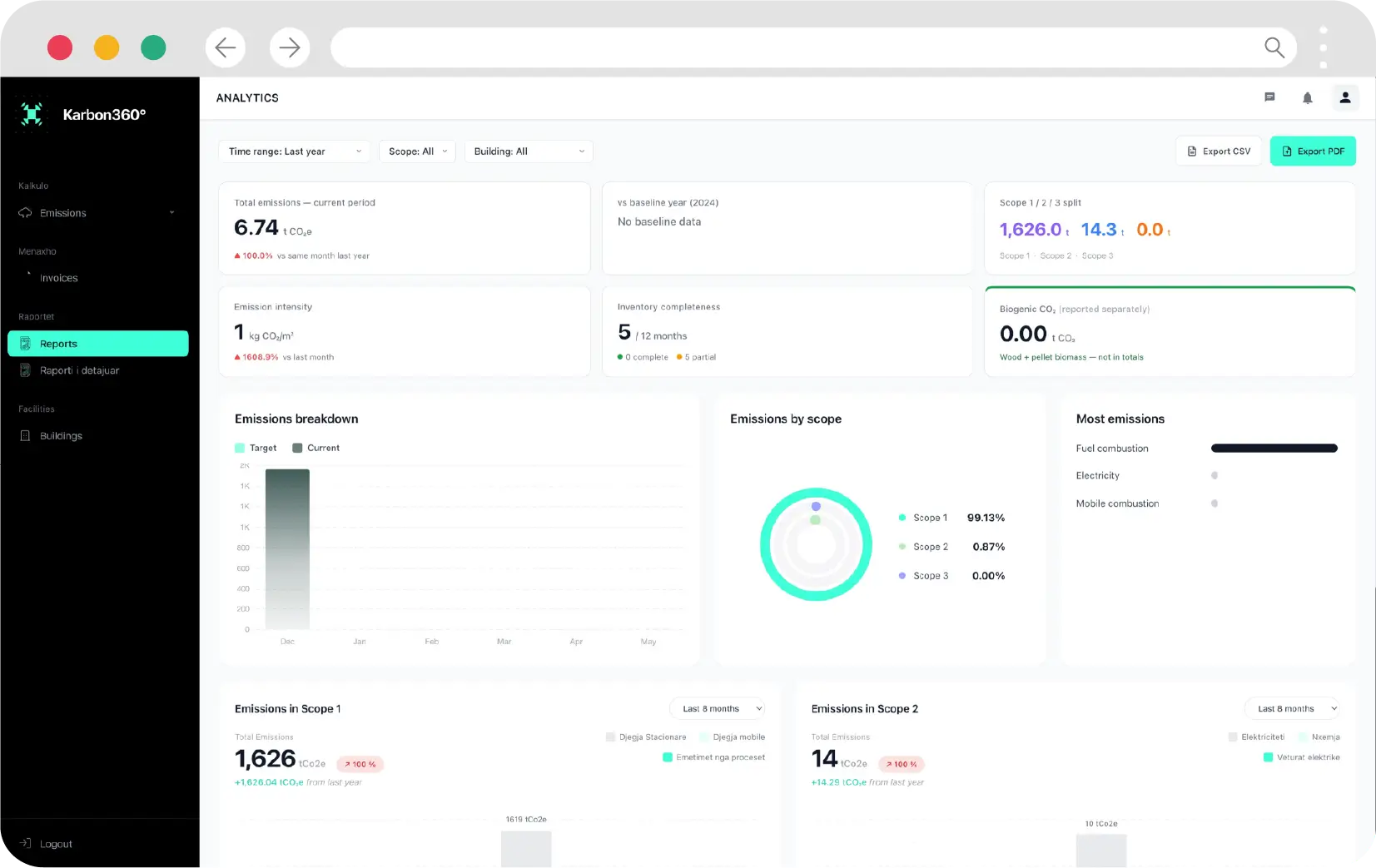
Habitat runs that capture as a standing process: structured supplier outreach, one emissions inventory per reporting year, and a documented default-versus-actual decision for every good — managed in Karbon360°.
Karbon360°
Karbon360° transforms energy and business activity data into structured greenhouse-gas inventories — one place for the installation data, emission factors and documentation your CBAM declaration draws on.
Under Article 26 of Regulation (EU) 2023/956 as amended, the base penalty for failing to surrender certificates is aligned with the EU ETS excess-emissions penalty: EUR 100 per tonne of CO2e, indexed to inflation. Importing CBAM goods without authorised-declarant status raises that to three to five times the base penalty — and paying a penalty never removes the obligation to surrender the outstanding certificates.
Frequently asked.
When is the first CBAM declaration due?
Is the CBAM declaration deadline in 2027 31 May or 30 September?
What does the 2027 CBAM annual declaration cover?
What are the CBAM penalties for non-compliance?
Can I use default values instead of actual emissions data?
Do small importers have to file a CBAM declaration?
File once, file right, file on time.
Habitat prepares CBAM annual declarations end to end — supplier data collection, the emissions inventory, certificate planning and the filing itself. Scope, timeline and price in writing within 48 hours.