What is CBAM — and how does it work in 2026?
What is CBAM? The Carbon Border Adjustment Mechanism is the EU's carbon price on imported cement, iron and steel, aluminium, fertilisers, electricity and hydrogen, established by Regulation (EU) 2023/956. The reporting-only transitional period ended on 31 December 2025. Since 1 January 2026 CBAM applies under its definitive regime: authorised importers declare the emissions embedded in their goods and pay for them through CBAM certificates priced off the EU ETS.
Six rules define the definitive regime.
The transitional period was practice: quarterly reports, no money. The definitive regime that has applied since 1 January 2026 is the real mechanism, and it rests on six rules.
CBAM goods above the de-minimis threshold may only be imported by an authorised CBAM declarant — the importer established in an EU Member State, or its indirect customs representative.
Due 30 September of the year after the import year, declaring the quantity of goods and their embedded emissions. The first, covering 2026 imports, is due 30 September 2027.
Certificate prices derive from EU ETS auction clearing prices — quarterly weighted averages for the 2026 import year, moving to weekly averages from 2027.
Declarants may use the Commission's default values (Implementing Regulation (EU) 2025/2621) instead of verified actual emissions — at a mark-up of 10% for 2026 imports, 20% for 2027 and 30% from 2028.
Importers below 50 tonnes net mass of CBAM goods per calendar year carry no authorisation, declaration or certificate obligations — for iron and steel, aluminium, fertilisers and cement, not electricity or hydrogen.
EUR 100 per tonne of CO2e for certificates not surrendered, indexed to inflation — and three to five times that for importing without authorised-declarant status (Article 26).
Legal base: Regulation (EU) 2023/956 of 10 May 2023, as amended by Regulation (EU) 2025/2083 — the simplification regulation of the European Parliament and the Council, in force since 20 October 2025.
CBAM from 2023 to 2027.
| Date | What it means |
|---|---|
| 1 October 2023 – 31 December 2025 | Transitional period: quarterly CBAM reports under Implementing Regulation (EU) 2023/1773 — reporting only, no certificates, no payment. Now closed. |
| 31 March 2025 | Applications for authorised CBAM declarant status open via the CBAM Registry, under Implementing Regulation (EU) 2025/486. |
| 1 January 2026 | The definitive regime applies. Only authorised declarants may import CBAM goods above the 50-tonne annual threshold, and the CBAM cost starts accruing. |
| 7 April 2026 | First quarterly certificate price for the 2026 import year published: EUR 75.36 for Q1 2026. |
| 1 February 2027 | Certificate sales open on the common central platform, covering 2026 imports retroactively. |
| 30 September 2027 | First annual CBAM declaration due and certificates surrendered — both for 2026 imports, on the same date. |
Sources: Regulation (EU) 2023/956 as amended by Regulation (EU) 2025/2083; European Commission CBAM certificate price page, 7 April 2026.
How does CBAM affect non-EU exporters?
The legal obligation sits on the EU side. The authorised CBAM declarant applies for authorisation, files the annual declaration, buys and surrenders certificates, and carries the penalties. Operators of installations outside the EU have no obligation under the Regulation itself.
That does not make the data request optional. Regulation (EU) 2023/956 defines exactly what the declarant must declare, so when an EU customer asks a Balkan, Turkish or US producer for installation-level embedded-emissions data, it is passing on a legal requirement — not a preference. Producers answer through the Commission's CBAM communication template for installations, a free Excel workbook, or through the operator module of the CBAM Registry, which exists precisely so non-EU operators can share installation and emissions data with their declarants.
The commercial logic is just as hard. Where a producer supplies no verified data, the importer falls back on default values plus the mark-up — 10% for 2026 imports, rising to 30% from 2028 — and that extra cost shapes who wins the next order. A supplier with clean, verified emissions data is simply cheaper to buy from. What to send when your EU customer asks for CBAM data covers the response step by step.
Since 1 January 2026, CBAM is no longer a reporting exercise — every declared tonne has a certificate behind it.
Embedded emissions, measured properly.
Everything in CBAM prices off one number: the embedded emissions of the imported good, calculated at installation level under the Regulation's methodology. Getting that number right — and verified — is what separates paying on actuals from paying defaults plus mark-up. The readable walkthrough: how to calculate embedded emissions for CBAM goods.
Habitat builds that capability on both sides of the border — for EU declarants preparing their first declaration, and for non-EU producers answering their customers' data requests — with the monitoring, calculation and documentation managed in Karbon360°.
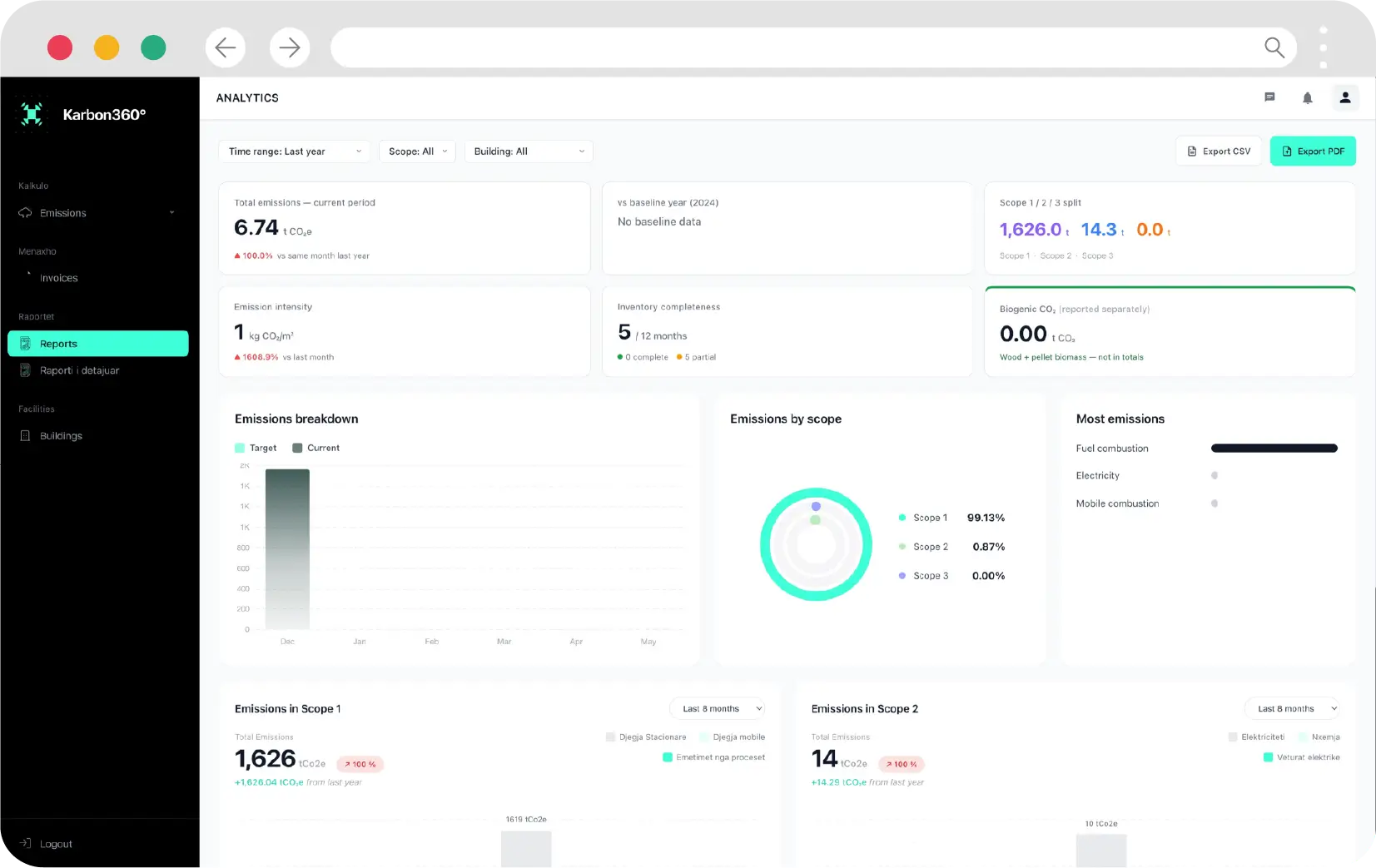
Karbon360°
Karbon360° transforms energy and business activity data into structured greenhouse-gas inventories — installation data, emission factors and documentation in one place, ready for a CBAM declaration or a customer's data request.
In December 2025 the Commission proposed extending CBAM to roughly 180 downstream, mainly steel- and aluminium-intensive product categories from 1 January 2028, with anti-circumvention measures alongside. The Council agreed its general approach on 12 June 2026, the European Parliament adopted its mandate on 15 September 2026, and trilogue negotiations were under way in October 2026. Until the final text lands, every product list is provisional — we track the extension here.
Frequently asked.
What is CBAM in simple terms?
What are the CBAM 2026 rules under the definitive period?
Who pays for CBAM — the importer or the exporter?
Which goods does CBAM cover?
How much does a CBAM certificate cost?
Is there a CBAM exemption for small importers?
Know where you stand before February 2027.
Whether you import CBAM goods into the EU or supply the companies that do, Habitat maps your exposure, builds the emissions data and keeps the deadlines. Scope, timeline and price in writing within 48 hours.