CBAM in Serbia: two carbon prices, one data problem.
Since 1 January 2026, Serbian exporters answer to two carbon systems at once: the EU's CBAM, now in its definitive regime and declared by your EU customers, and Serbia's own carbon tax, in force since the very same day. This guide covers what Regulation (EU) 2023/956 really asks of a Serbian producer, the dates that matter, and the numbers your buyer needs from you.
Serbian exporters sit between two carbon systems.
The CBAM transitional period (October 2023 – December 2025) is over. More than 60% of Western Balkan goods exports go to the EU, which makes the region one of the most CBAM-exposed in the world — and 1 January 2026 brought three changes at once.
Your EU customers now declare the embedded emissions of the cement, iron and steel, aluminium, fertilisers, electricity and hydrogen they import from Serbia, and surrender CBAM certificates against them.
A national tax on greenhouse-gas emissions — EUR 4 per tonne — applies to industrial operators holding emissions permits, in force since 1 January 2026.
A border levy on carbon-intensive imports mirrors the EU CBAM product list (electricity excluded for now) and is planned to rise annually toward EU ETS price parity by 2034.
The EU-side legal duty sits on your customer, the authorised CBAM declarant — but Regulation (EU) 2023/956 defines exactly which installation-level data they must collect from you. That is why the request lands in your inbox, and why it is not optional goodwill.
Who actually owes what?
The CBAM obligation — authorisation, the annual declaration, buying and surrendering certificates — belongs to the EU importer. So do the penalties: EUR 100 per tonne of CO2e at base, and three to five times that for importing CBAM goods without authorised-declarant status. None of that can be enforced against a Serbian company.
Your role is defined just as precisely. As a non-EU operator of an installation, you supply installation-level embedded-emissions data through the European Commission's free communication template for installations, and you can register in the operator module of the CBAM Registry to share that data with every declarant who buys from you — once, instead of once per customer.
If you send nothing, your customer does not simply give up. Since the 2025 simplification regulation they may fall back on the Commission's default values under Implementing Regulation (EU) 2025/2621 — but a mark-up applies when defaults replace actual data: 10% for 2026 imports, 20% for 2027 and 30% from 2028. Your goods are then declared dirtier than they probably are, and cost more than a competitor's who provided verified numbers. That is the real commercial pressure on Serbian steel, aluminium, cement and fertiliser producers.
CBAM Serbia: the dates that matter.
| Date | What happens |
|---|---|
| 1 Oct 2023 – 31 Dec 2025 | Transitional period — quarterly reporting only. Closed. |
| 1 January 2026 | CBAM definitive regime applies. Serbia's EUR 4/t emissions tax and its border levy on carbon-intensive imports enter into force the same day. |
| 7 April 2026 | First quarterly CBAM certificate price published for Q1 2026: EUR 75.36, derived from EU ETS auction prices. |
| 1 February 2027 | CBAM certificate sales open on the central platform, retroactively covering the 2026 import year. |
| 30 September 2027 | First annual CBAM declaration due, and certificates for 2026 imports surrendered, by the EU declarant. |
Dates per Regulation (EU) 2023/956 as amended by Regulation (EU) 2025/2083; the Q1 2026 certificate price per the European Commission's CBAM price page.
There is no EU decision recognising Serbia's EUR 4 per tonne tax for a CBAM Article 9 deduction, and the Article 9 implementing act was still a draft as of late 2026. Treat every "our local tax offsets CBAM" claim as unconfirmed until the act and a scheme-specific recognition exist. We track the state of play on our Article 9 carbon-price deduction page.
What a CBAM consultant in Serbia actually delivers.
Habitat works with exporters across the Western Balkans. For a Serbian producer the job is four deliverables, built once and repeated every year.
Habitat also runs broader engagements in the country — corporate carbon footprint calculation for companies in Serbia, GHG inventories and buyer-questionnaire support — under ESG consulting for Serbia.
One dataset serves every request.
Most Serbian exporters do not need a lawyer in Brussels. They need installation-level numbers their customers can legally declare, and a process that repeats every year without drama.
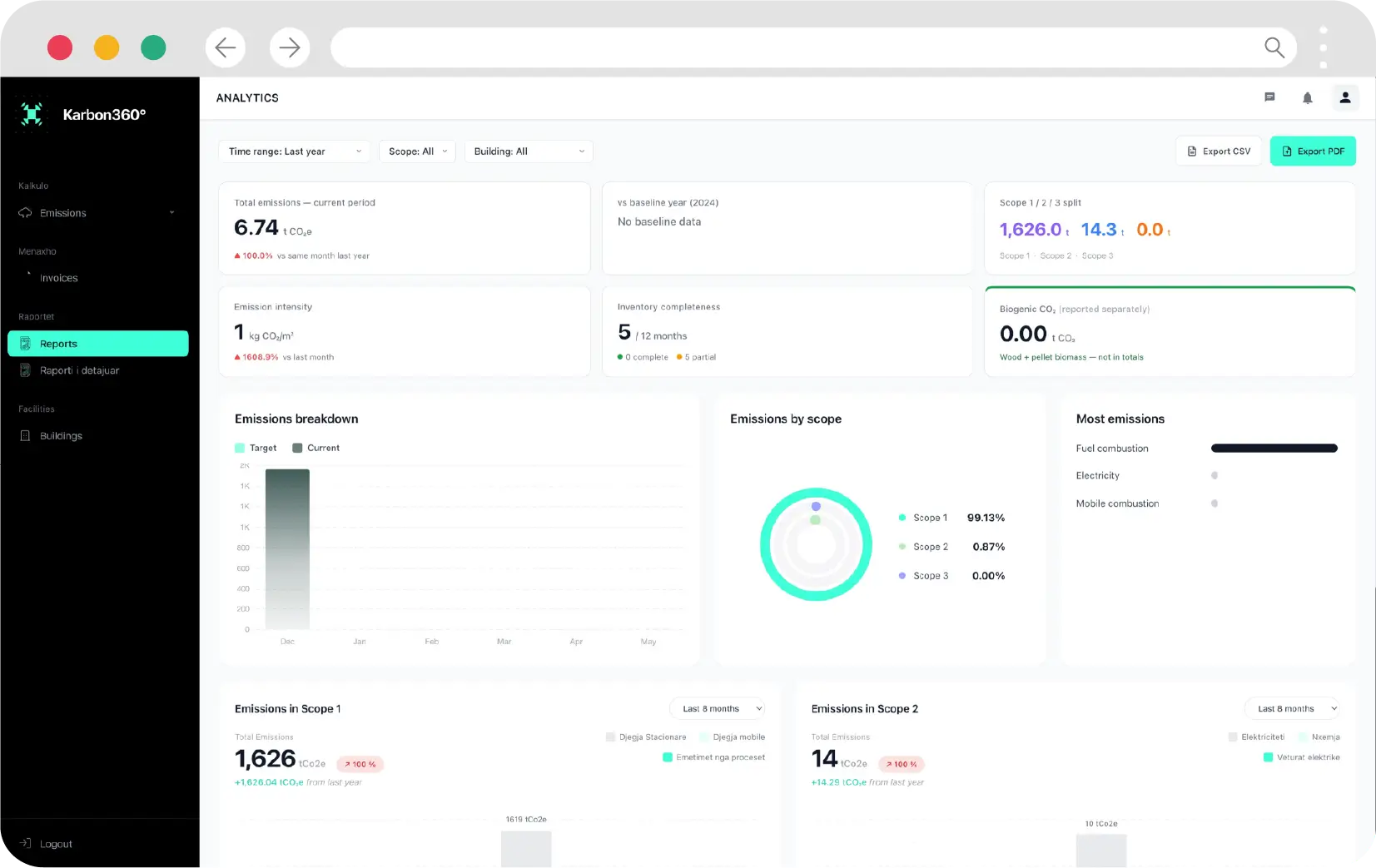
We set that up once: a monitoring approach, country-specific emission factors, the Commission's communication template and registry access to share it. The software behind it is Karbon360°, our own ClimateTech platform.
Karbon360°
Karbon360° transforms energy and production data into structured, GHG Protocol-based greenhouse-gas inventories — the same numbers that feed the CBAM communication template, your buyer's declaration and your company's own carbon footprint.
Frequently asked.
Does CBAM apply to Serbian exporters directly?
What is Serbia's carbon tax in 2026?
Can Serbia's EUR 4 tax be deducted from our customer's CBAM bill?
What happens if we do not send emissions data to our EU customer?
Does the 50-tonne exemption cover our buyers?
What about electricity exports from Serbia?
Two carbon systems, one data layer.
Tell us what you export and who buys it. We come back within 48 hours with scope, timeline and a fixed-fee quote in writing.