EU ESG reporting requirements in 2026, mapped.
Between October 2025 and July 2026 the EU rewrote its sustainability rulebook: CBAM entered its definitive regime, the Omnibus package narrowed CSRD, the ESRS were simplified, VSME became the SME default and ETS2 settled on 2028. This page maps the EU ESG reporting requirements that actually apply in 2026 — each regime, its legal act, who it covers and the next date. We maintain it as the rules move; the change log below records every revision.
One rulebook, five moving parts.
Five regimes shifted between autumn 2025 and mid-2026. Here is where each stands today — the legal detail follows below.
Since 1 January 2026, only authorised CBAM declarants may import covered goods above the 50-tonne threshold. The cost accrues through 2026; certificate sales open on 1 February 2027.
Directive (EU) 2026/470, in force since 18 March 2026, limits mandatory reporting to undertakings with more than 1,000 employees and over EUR 450 million net turnover — both tests at once.
The Commission adopted the revised standards on 3 July 2026. They apply mandatorily from financial years beginning 1 January 2027, with voluntary early use for FY2026 if published in time.
EFRAG's voluntary standard, annexed to Commission Recommendation (EU) 2025/1710, is now the EU's designated answer for SMEs — and the cap on what large buyers should ask suppliers for.
The second trading system prices fuel for buildings, road transport and smaller industry. Fuel suppliers pay, not households — and their permit and reporting duties are already running.
Fewer companies report because a law says so. More companies report because a customer, an importer or a bank cannot legally do without their data.
What EU ESG rules actually apply in 2026.
As of 2026, four EU instruments shape corporate sustainability obligations. The CBAM definitive regime applies since 1 January 2026 under Regulation (EU) 2023/956, as amended by Regulation (EU) 2025/2083, in force since 20 October 2025. CSRD remains in force, rescoped by Directive (EU) 2026/470. VSME stands as the voluntary reporting route for SMEs under Recommendation (EU) 2025/1710. And ETS2, created by Directive (EU) 2023/959, is in its preparation phase ahead of full operation in 2028.
The legal duties sit in specific places. Under CBAM, the obligation — authorisation, the annual declaration, certificates — belongs to the EU importer, the authorised CBAM declarant. Non-EU producers carry no obligation under the Regulation, but their EU customers are legally required to declare embedded-emissions data that the Regulation defines in detail, which is why the data request still lands with exporters. Under CSRD, wave-1 companies have already reported for FY2024 and FY2025 under the existing ESRS, while undertakings above the new thresholds prepare for FY2027 reports due in 2028.
Just as important is what 2026 does not require. Listed SMEs no longer face mandatory CSRD reporting. Importers below the 50-tonne CBAM de-minimis — which covers iron and steel, aluminium, fertilisers and cement, but not electricity or hydrogen — have no authorisation, declaration or certificate duties for those goods. And the proposed CBAM extension to downstream, mainly steel- and aluminium-intensive products from 2028 is exactly that: a proposal, in trilogue as of autumn 2026, not law. Companies facing a first report can start from a CSRD readiness and gap analysis rather than from the regulation text.
The post-Omnibus map, rule by rule.
| Regime | Legal basis | Who it covers | Where it stands in 2026 | Next date |
|---|---|---|---|---|
| CBAM | Reg. (EU) 2023/956, amended by Reg. (EU) 2025/2083 | EU importers of cement, iron and steel, aluminium, fertilisers, electricity and hydrogen | Definitive regime since 1 Jan 2026; 50 t per-importer de-minimis for the mass-based goods | 1 Feb 2027 — certificate sales open |
| CSRD | Directive (EU) 2026/470 (Omnibus I), in force 18 Mar 2026 | Undertakings with more than 1,000 employees and over EUR 450m net turnover; non-EU groups via EUR 450m EU net turnover | Wave 1 reports under the existing ESRS; Member-State transposition due by 19 Mar 2027 | 2028 — first wave-2 reports, on FY2027 |
| ESRS (revised) | Delegated act of 3 Jul 2026, amending Delegated Reg. (EU) 2023/2772 | Every company reporting under CSRD | Adopted; in the Parliament and Council scrutiny period as of October 2026 | FYs from 1 Jan 2027 — mandatory application |
| VSME | Commission Recommendation (EU) 2025/1710 of 30 Jul 2025 | Non-listed SMEs — and, as the value-chain cap, the large companies and banks requesting their data | Voluntary; the designated reporting language below the CSRD thresholds | — (an eventual delegated act may follow) |
| ETS2 | Directive (EU) 2023/959 | Fuel suppliers for buildings, road transport and smaller industry; costs pass through fuel prices | Permits required since 1 Jan 2025; reporting running, with verified data from 2026 | 2028 — fully operational |
Status as of 31 October 2026, per EUR-Lex and the European Commission's CBAM, finance and climate pages. The change log below records each revision of this page.
Between now and 2028 the calendar runs: 1 February 2027 — CBAM certificate sales open on the common central platform, covering 2026 imports retroactively. 19 March 2027 — deadline for Member States to transpose Directive (EU) 2026/470. 30 September 2027 — the first annual CBAM declaration, for 2026 imports, is due, with certificates surrendered by the same date. Financial years from 1 January 2027 — the revised ESRS apply mandatorily, making FY2027 the data year behind the 2028 CSRD reports. 2028 — ETS2 becomes fully operational. One budgeting note for importers: through 2026 the CBAM cost accrues but cannot yet be paid. The Q1 2026 certificate price — EUR 75.36, published 7 April 2026 — is the published reference, and provisioning against the quarterly averages is the only preparation possible before February 2027.
Different rules, same data.
Strip the acronyms away and every regime on this page asks for the same underlying asset: a greenhouse-gas inventory built on the GHG Protocol, with country-specific emission factors. CBAM wants installation-level embedded emissions per product. CSRD and VSME want the corporate footprint across scope 1, scope 2 and scope 3. Banks and large customers want the same numbers again, in questionnaire form.
Building that dataset once — and keeping it verifiable — beats answering each request from scratch. A corporate carbon footprint done properly in 2026 feeds the CBAM communication template, a VSME report and a CSRD gap analysis alike.
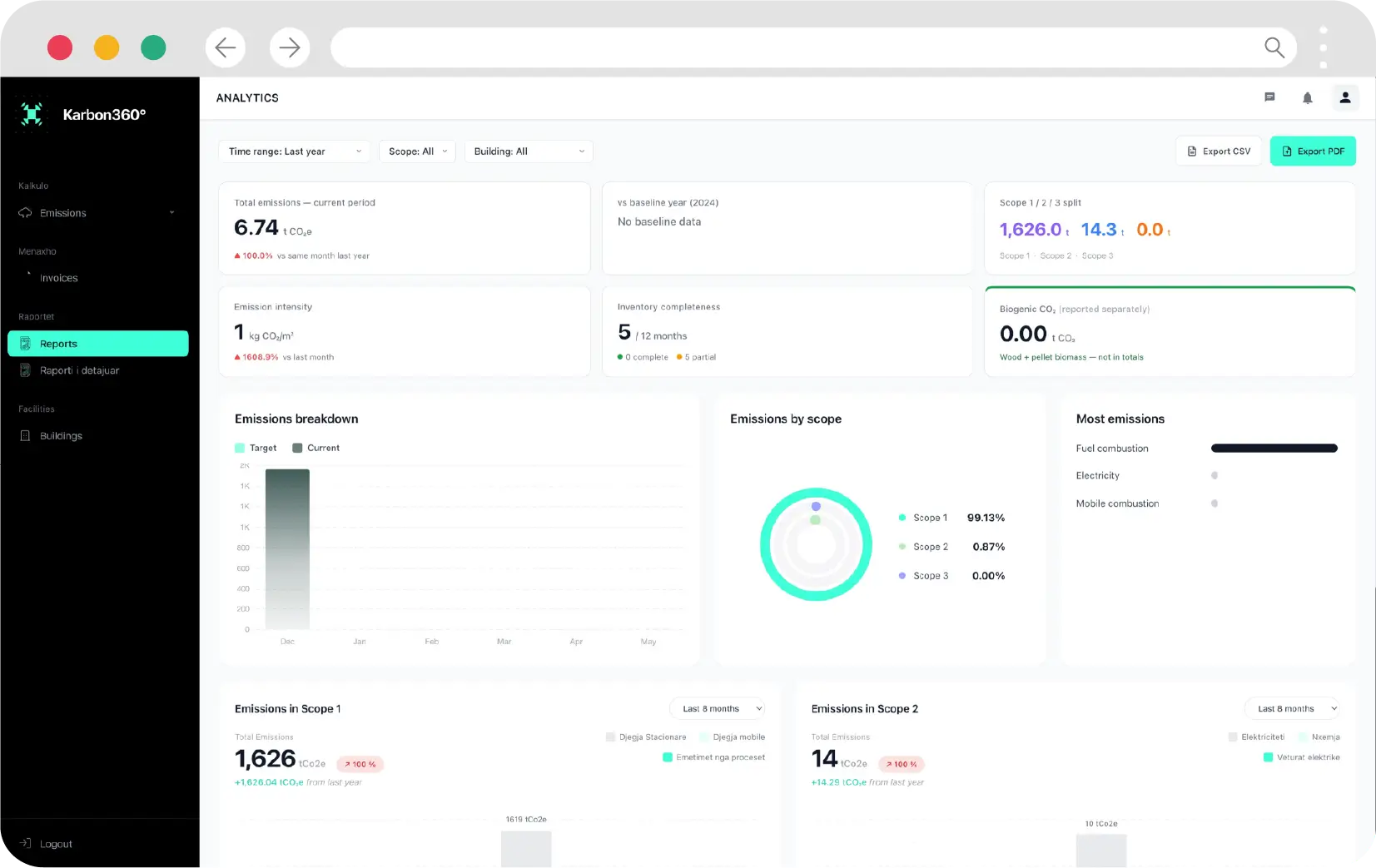
Karbon360°
Karbon360° transforms energy and business activity data into structured greenhouse-gas inventories under the GHG Protocol, with country-specific emission factors — one dataset that answers CBAM, CSRD, VSME and bank requests alike.
What changed, and when.
- 14 April 2025 — Directive (EU) 2025/794, the stop-the-clock directive, postpones wave-2 and wave-3 CSRD reporting by two years.
- 30 July 2025 — the VSME standard is annexed to Commission Recommendation (EU) 2025/1710 as the voluntary standard for SMEs and the value-chain cap.
- 20 October 2025 — Regulation (EU) 2025/2083 enters into force: a 50-tonne de-minimis replaces the EUR 150 consignment rule, default values become usable in the definitive period, and the first declaration moves to 30 September 2027.
- December 2025 — Implementing Regulation (EU) 2025/2621 sets the definitive-period default values, with a 10% mark-up on defaults for 2026 imports, 20% for 2027 and 30% from 2028 (actual verified emissions carry no mark-up). The Commission also proposes extending CBAM to downstream products from 2028.
- 1 January 2026 — the CBAM definitive regime applies; only authorised declarants may import covered goods above the threshold.
- 26 February / 18 March 2026 — Omnibus I, Directive (EU) 2026/470, is published and enters into force: mandatory CSRD narrows to more than 1,000 employees and EUR 450 million net turnover, and listed SMEs leave the scope.
- 7 April 2026 — the first quarterly CBAM certificate price is published: EUR 75.36 for Q1 2026.
- 3 July 2026 — the delegated act on the revised, simplified ESRS is adopted, applying mandatorily from financial years beginning 1 January 2027.
- Autumn 2026 — the proposed downstream CBAM extension sits in trilogue, after the Council's general approach of 12 June 2026 and Parliament's mandate of 15 September 2026. Still a proposal, not law.
Frequently asked.
What are the EU ESG reporting requirements in 2026?
What are the CSRD requirements in 2026?
What is ETS2?
What changed in the revised ESRS for 2026?
ISSB vs ESRS — which applies to EU companies?
Does CBAM already apply in 2026?
Turn this map into your plan.
Send us your sector, size and markets. Habitat maps your exposure across CBAM, CSRD, VSME and ETS2, tells you which obligations are real and which are noise, and puts scope, timeline and price in writing.