CBAM for Turkish exporters.
Turkish steel, aluminium, cement and fertiliser producers now sell into a market where every EU buyer of CBAM goods files a carbon declaration built on supplier data. Since 1 January 2026 the mechanism — SKDM in Turkish — has applied in its definitive regime, and this page is the working guide to CBAM in Turkey: what your EU customers must declare, what they will ask you for, and how Habitat prepares it installation by installation.
What changed on 1 January 2026.
The transitional period (1 October 2023 – 31 December 2025) is over. Under Regulation (EU) 2023/956, as amended by Regulation (EU) 2025/2083, the definitive regime has applied since 1 January 2026 — and it changed what your EU customers need from you.
Only authorised CBAM declarants may import CBAM goods above the de-minimis threshold. They file the annual declaration and surrender the certificates — built on installation-level data from suppliers like you.
Importers may fall back on Commission default values, but with a mark-up: 10% for 2026 imports, 20% for 2027, 30% from 2028. Verified actual data carries no mark-up.
The Q1 2026 certificate price, EUR 75.36 per tonne, was published on 7 April 2026. Certificate sales open on 1 February 2027 and cover 2026 imports retroactively.
From data request to declaration-ready.
Habitat works with Turkish producers the way the regulation is written: the installation is the unit of work, and the output is a dataset your EU customer can declare without rework.
Most Turkish engagements start with a short exposure screening. You get scope, timeline and price in writing — a fixed-fee quote within 48 hours.
One dataset, every customer.
Most Turkish exporters serve more than one EU customer, and each declarant asks for the same thing in a slightly different form. The answer is not a new spreadsheet per request. It is one installation-level dataset — built once, maintained on a fixed rhythm, and shared through the operator module of the CBAM Registry.
Habitat structures your energy, production and precursor data so that every request — importer, verifier or auditor — is answered from the same source. The data work runs on Karbon360°, our own platform.
Karbon360°
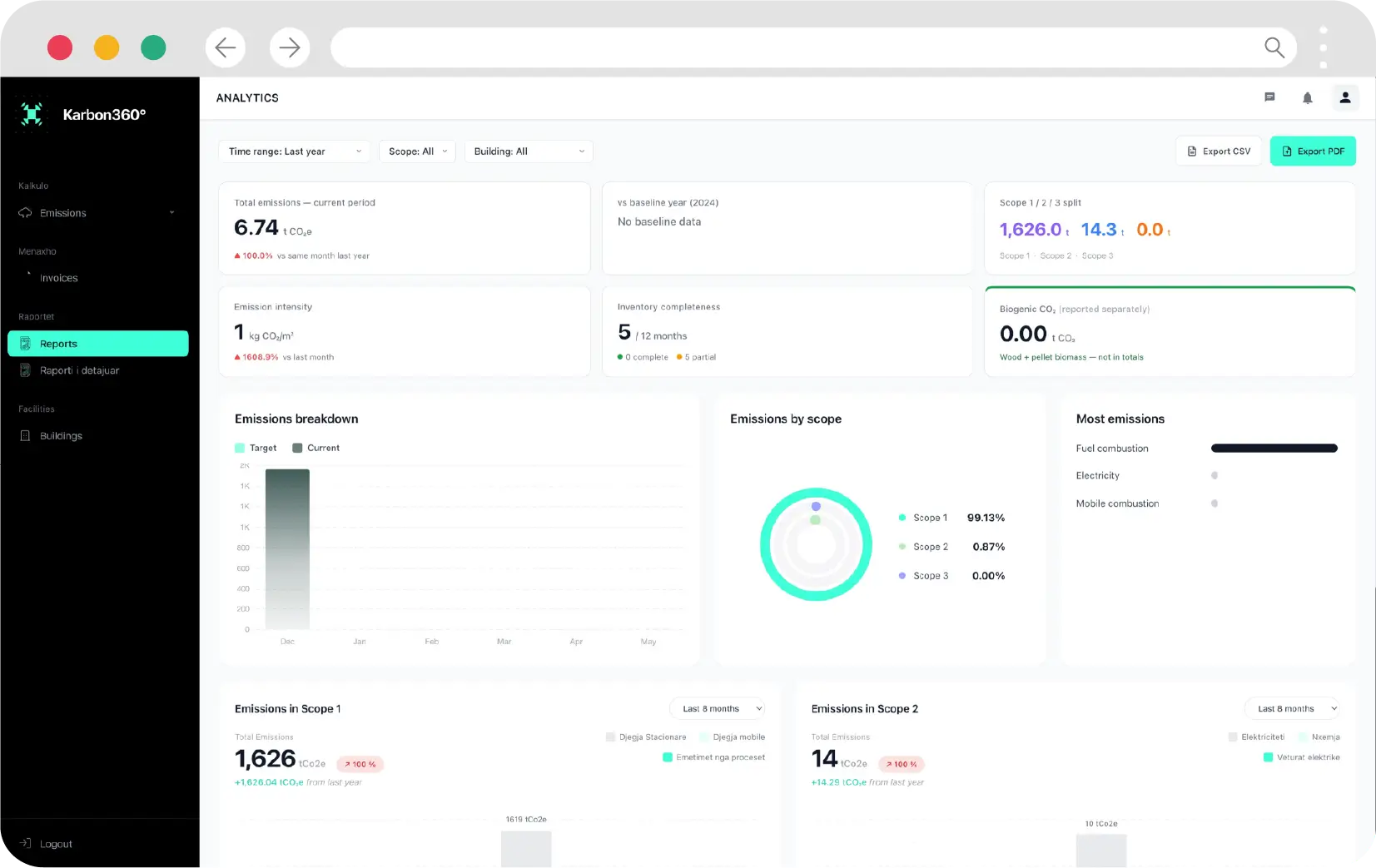
Karbon360° transforms energy and business activity data into structured greenhouse-gas inventories and CBAM-ready embedded-emissions datasets — built by Habitat and used in every Turkish engagement.
The definitive-regime calendar.
| Date | What happens | Who acts |
|---|---|---|
| 1 January 2026 | Definitive regime applies; only authorised CBAM declarants may import CBAM goods above the de-minimis threshold | EU importer |
| 31 March 2026 | Importers that lodged their authorisation application by this date could keep importing while it was pending | EU importer |
| 1 February 2027 | Certificate sales open on the common central platform, covering 2026 imports retroactively | EU importer |
| 30 September 2027 | First annual CBAM declaration due, covering 2026 imports; certificates for 2026 surrendered by the same date | EU importer — using your data |
Regulation (EU) 2023/956 as amended by Regulation (EU) 2025/2083. The supplier's work sits ahead of every row: the data must exist before the declaration can.
Climate Law No. 7552 and the Turkish ETS.
Turkey is building its own carbon-pricing architecture. Climate Law No. 7552 entered into force on 9 July 2025 and created the legal basis for a national emissions trading system. The implementing ETS regulation followed in Official Gazette No. 33353 on 27 August 2026, and operators have three years from the Climate Law to obtain their emission permits.
What this does not yet do is lower a CBAM bill. Article 9 of Regulation (EU) 2023/956 lets an EU declarant reduce the certificates it surrenders to reflect a carbon price effectively paid in the country of origin — but as of late 2026 the Turkish system does not yet impose an effectively paid carbon price, and the Article 9 implementing act itself was still a draft in October 2026. Until both change, no Turkish scheme can be counted on for a deduction. We track the moving parts on our Article 9 page.
Scope is moving on the EU side too. A proposal to extend CBAM to downstream, mainly steel- and aluminium-intensive products from 1 January 2028 — directly relevant to Turkish fastener, component and finished-goods exporters — was in trilogue negotiations as of October 2026. It is not law yet. Treat it as a planning horizon, not an obligation.
Your EU customer is legally required to declare these numbers. The regulation decides what they must ask you for.
Frequently asked.
Does CBAM apply to Turkish exporters?
Which Turkish exports count as CBAM goods?
What does CBAM compliance involve for steel exporters to the EU?
Will Turkey's new ETS reduce CBAM costs for our EU customers?
What happens if we send no data at all?
Be the supplier whose numbers hold.
Tell us your products, CN codes and EU markets. You get scope, timeline and price in writing — and a dataset your customers can declare without rework.