Your bank sent an ESG questionnaire.
When a bank ESG questionnaire lands — or a supplier ESG data request from your biggest customer — the questions are more standard than they look. Most are built on the VSME standard, the EU's voluntary sustainability reporting format for SMEs. Habitat decodes the questionnaire, gathers the data with you and returns finished, evidence-backed answers — typically within two weeks.
Why banks ask SMEs for ESG data.
You are not being singled out. Three facts explain the attachment in your inbox.
Large EU banks already publish sustainability reports under the EU framework, and a lender's sustainability picture sits largely in the businesses it finances. To describe their own portfolio, they need numbers from their borrowers — which is how the questionnaire reaches you.
After the Omnibus changes, mandatory CSRD reporting covers undertakings with more than 1,000 employees and more than EUR 450 million net turnover; Directive (EU) 2026/470 removed listed SMEs from mandatory scope. SMEs rarely report directly — the demand reaches them through banks and large customers instead.
The VSME standard — developed by EFRAG and annexed to Commission Recommendation (EU) 2025/1710 of 30 July 2025 — is the EU's voluntary reporting format for SMEs, designed as the value-chain cap on what banks and large companies ask suppliers for. Questionnaires are converging on it, the banking sector's harmonised SME templates included.
That is why the same spreadsheet keeps arriving — from your bank, then your largest customer, sometimes an insurer. Answer it once in the standard's own structure, and every copy after the first is an update, not a new project.
What the questionnaire actually asks.
Strip away the formatting and nearly every bank or supplier questionnaire covers the same ground VSME covers: energy and greenhouse-gas emissions; environment topics such as waste and water where your sector makes them relevant; workforce basics — headcount, contracts, health and safety; and business conduct, from anti-corruption to who owns which policy. Most SMEs already hold this information. It just lives in utility bills, HR files and drawer-bottom policies rather than in one document.
The block that stalls most companies is emissions. Done properly it follows the GHG Protocol: Scope 1 is what you burn — heating fuels, process fuels, company vehicles; Scope 2 is purchased electricity, heat and cooling, reported with a location-based and a market-based figure per the Scope 2 Guidance. The emission factors behind the numbers are country-specific, never regional averages. Some questionnaires also touch Scope 3 — the value-chain emissions explained in our Scope 1, 2 and 3 guide — though for a first SME response the weight sits firmly on Scopes 1 and 2.
If a question reaches well beyond this, the value-chain cap is your reference point: Recommendation (EU) 2025/1710 asks large companies and banks to limit the sustainability data they demand from SME suppliers to what VSME covers. The cap is a recommendation, not a prohibition — but it gives you solid ground to discuss scope with your bank instead of guessing.
Two weeks is a realistic timeline for a typical SME — provided the data hunt is organised rather than improvised. The collection list below is where every engagement starts.
From questionnaire to submission in two weeks.
Gather this before you start.
- Twelve months of electricity bills — kWh per site, plus supply contracts if you purchase certified green power (that is what the market-based figure is built on).
- Heating and process fuels — litres, cubic metres or kWh of diesel, gas, pellets or coal, per site.
- Vehicle fuel — fuel cards or litres purchased for company cars, vans and machinery.
- Workforce basics from HR — headcount, contract types, and health-and-safety records such as incidents and training.
- Policies you already have — environment, ethics and anti-corruption, data protection — in whatever state they are in.
- Waste and water figures where your sector makes them material — contractor invoices usually carry the tonnages.
- Any previous ESG answers — last year's bank form, a customer spreadsheet, an EcoVadis or CDP response — so nothing is answered inconsistently twice.
Answer once, reuse everywhere.
The bank is rarely the only asker. Large customers send supplier ESG data requests in their own templates; procurement teams point to EcoVadis, which scores companies 0–100 across environment, labour and human rights, ethics and sustainable procurement; investors and corporate buyers ask for CDP responses, scored A to D−. Underneath, they all want the same evidence-backed dataset.
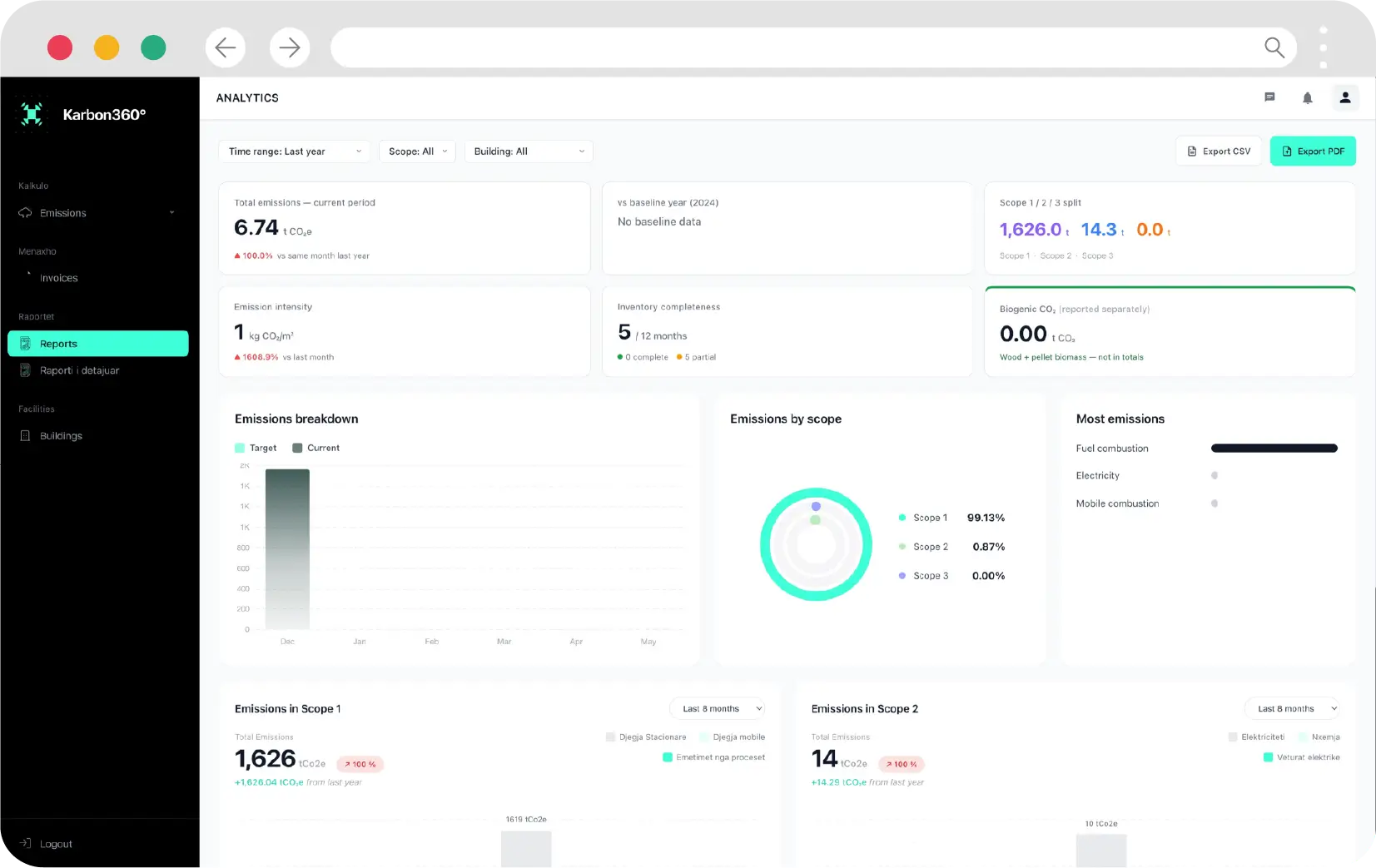
Habitat builds that dataset once. Our ClimateTech platform Karbon360° keeps your energy, fuel and workforce data structured year over year — so the next questionnaire, whoever sends it, starts from a living record instead of a blank page.
Karbon360°
Karbon360° transforms energy and business activity data into structured greenhouse-gas inventories — one source of truth behind every questionnaire you answer.
Habitat answers it with you.
One engagement, from the forwarded questionnaire to a submitted response and a reusable dataset.
Send the questionnaire exactly as you received it. You will have scope, timeline and price in writing — a fixed-fee quote within 48 hours.
Bank ESG questionnaires, answered.
What does a bank ESG questionnaire ask for?
Why is my bank asking for ESG data at all?
Is ESG reporting mandatory for SMEs in the EU?
How do I respond to a supplier ESG data request from a large customer?
What is the value-chain cap, and does it limit what my bank can ask?
Can the same answers be used for an EcoVadis questionnaire?
Turn the questionnaire into a finished answer.
Forward us the ESG questionnaire your bank or customer sent, exactly as it arrived. Habitat decodes it, gathers the data with you and returns submission-ready answers — with scope, timeline and price in writing within 48 hours.